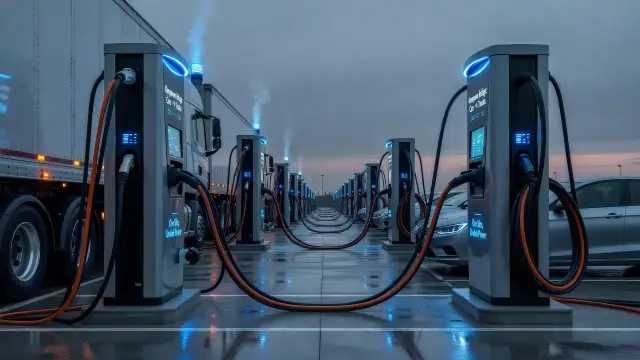
Kempower Charger Bridges Cars and Trucks on One Site
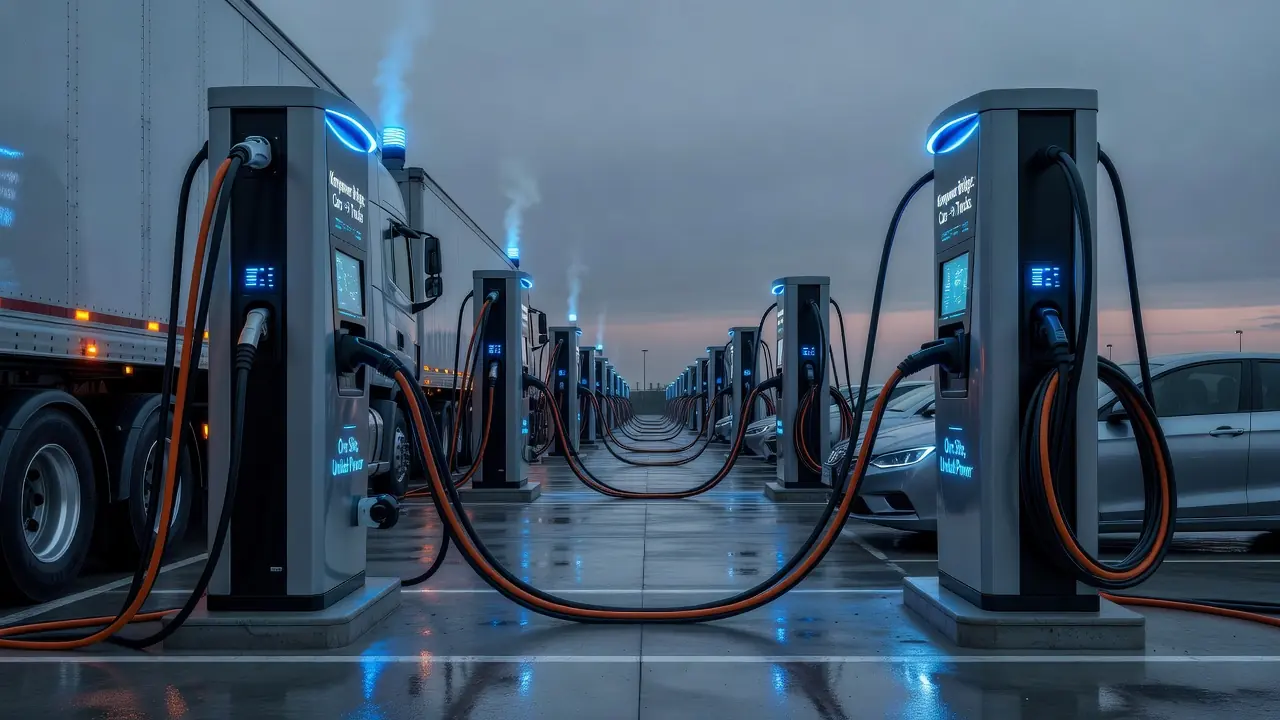
Kempower has introduced the Mega Satellite Flex, a high-power charging unit designed to serve both passenger EVs and heavy-duty electric trucks from a single piece of hardware. The Finnish charging manufacturer unveiled the product at its Unplug & Recharge event during ACT Expo, where it remains on display this week. It is the company's first dispenser capable of switching between the established Combined Charging System (CCS) standard and the emerging Megawatt Charging System (MCS) built specifically for freight vehicles.
The timing reflects a genuine industry bottleneck. CCS remains the dominant charging protocol for cars and light commercial vehicles, delivering up to 560 kW in this unit's configuration, while MCS is only now being deployed at scale to meet the far greater power demands of electric trucks and buses, which the Mega Satellite Flex can serve at up to 1.2 MW. Operators weighing which standard to build around, and when, face a decision with long-term financial consequences, and anyone comparing the underlying trade-offs between charging protocols may find a clear explanation of the trade-offs useful context before committing capital to one path or the other.
Why One Dispenser for Two Vehicle Classes Matters
Fleet operators and charging site developers have historically had to choose: build for cars now and add truck infrastructure later, or gamble on early truck-charging demand that may not materialize for years. Kempower's approach removes that binary choice. A site owner can install the Mega Satellite Flex today, serve passenger EVs immediately, and simply plug in the MCS side of the system once heavy-duty electric trucks become common on a given route. That flexibility matters because MCS infrastructure is still nascent; most electric trucks on the road today rely on lower-power charging or are concentrated in pilot fleets, meaning demand will ramp up unevenly over the next several years.
The unit also supports 800-volt vehicle architectures, an increasingly common feature in newer EV models designed for faster charging. Because voltage and current together determine charging speed, a dispenser capable of handling up to 1,500 amps for MCS and 700 amps for CCS can accommodate a wide range of vehicle designs without requiring separate hardware for each.
Infrastructure Economics and Site Utilization
Charging hardware is expensive to install, and electrical grid connections, permitting, and construction costs often dwarf the price of the dispenser itself. A charger that serves both car and truck traffic effectively doubles the potential customer base for a single site, which directly affects how quickly an operator recovers its investment. Idle chargers generate no revenue, so keeping utilization high from the moment a site opens is central to the business case for public charging networks.
Kempower says the Mega Satellite Flex works with its existing distributed charging architecture, meaning operators already using its power cabinets and satellite units can add the new dispenser without redesigning their sites. Cable lengths of 5 meters for CCS and 2.7 meters for MCS are intended to accommodate different vehicle types and parking configurations, and an optional payment terminal allows the unit to function as a standalone public charging point rather than one tied to a fleet account.
What Comes Next
The Mega Satellite Flex is expected to reach the North American and European markets in July 2026, giving operators a runway to plan sites around a technology still being finalized across the industry. MCS standardization has involved considerable coordination among vehicle manufacturers, charging equipment makers, and standards bodies, and hardware that can serve either protocol offers a hedge against uncertainty about how quickly truck electrification will scale in any given region.