Baccarat Rules for Beginners: How Baccarat Works, Game Setup & Gameplay, Betting Strategies, and Payouts/Odds
A hand of baccarat lasts less than a minute, involves no decisions beyond a single wager, and carries one of the lowest house edges of any casino table game. Yet most first-time players stand at the rail for several rounds before working up the nerve to sit down, convinced the game is reserved for high rollers in tuxedos. That reputation is mostly theater. The mechanics underneath are simpler than blackjack and far less demanding than poker.
The confusion usually comes from the vocabulary - "Banker," "Player," "natural," "tie" - thrown around a table where nobody explains what any of it means. Once you strip away the ceremony, baccarat rules for beginners boil down to three betting options and a fixed set of drawing rules that the dealer executes automatically. If you want a concise breakdown of the game's origins and core mechanics before diving into strategy, baccarat rules for beginners is a useful starting reference. For everyone else, this guide covers what you actually need on the felt: how the cards are valued, how a round unfolds, which bets make sense, and what the real payout structure looks like once commissions are factored in.
By the end, you'll know exactly what to expect at any live or online baccarat table, and why the game's simplicity is precisely what makes it worth understanding well.
How Baccarat Works
Baccarat is a comparison card game played between two hands, called Player and Banker. Despite the names, neither hand belongs to the actual dealer or to any specific gambler at the table - they're simply labels for the two positions you can bet on. A third option, Tie, pays out when both hands finish with equal totals. Understanding how baccarat works starts with recognizing that you are never making decisions about how to play a hand. You are only choosing which of the three outcomes to bet money on before the cards are dealt.
Card Values and Hand Totals
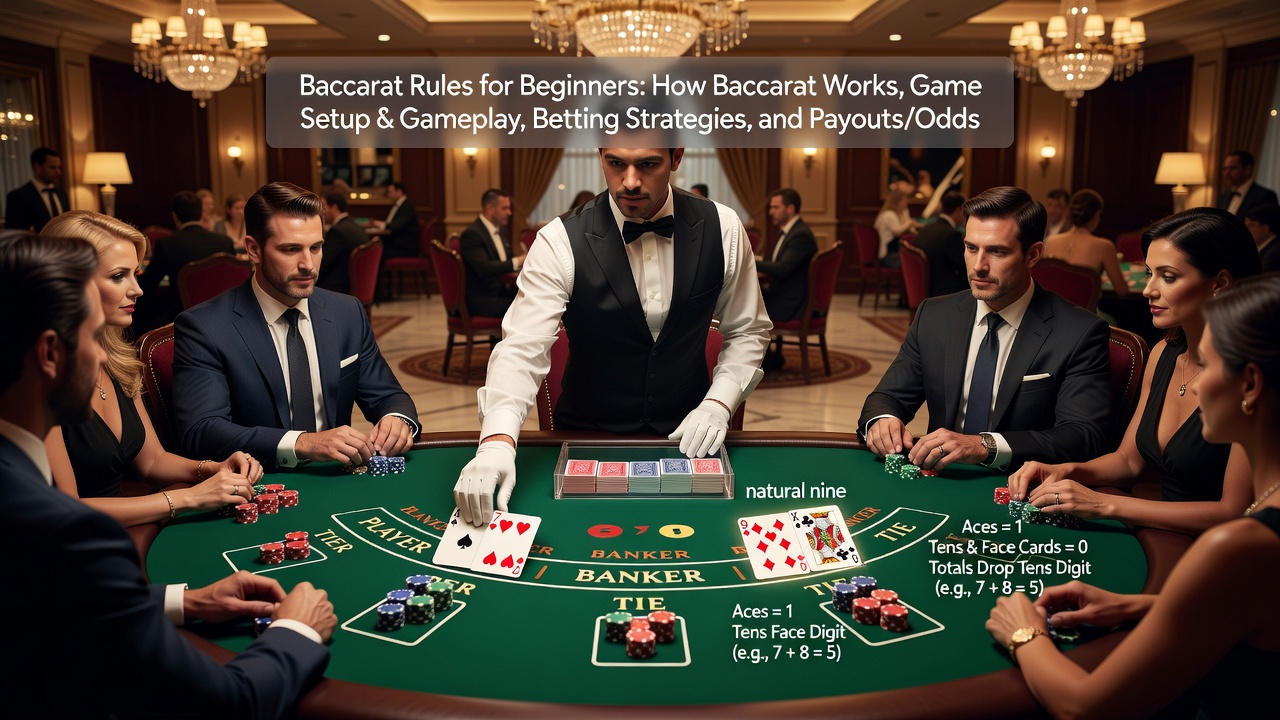
Cards two through nine keep their face value. Tens and face cards (jack, queen, king) count as zero. Aces count as one. When a hand's total exceeds nine, only the second digit counts - a hand of 7 and 8 totals 15, which becomes 5. This "drop the tens digit" rule is the single most important mechanic to internalize, because every outcome in the game flows from it.
The Objective of the Game
The goal is to hold, or bet on, whichever hand's total lands closest to nine. A hand totaling eight or nine on the first two cards is called a "natural," and it wins immediately unless the opposing hand also draws a natural of equal or higher value. There is no bust condition like in blackjack - a third card is drawn or withheld according to fixed rules, not player choice.
Why the Banker Hand Has an Edge
Because the Banker hand acts second and reacts to the Player hand's third-card draw, it holds a slight mathematical advantage. Casinos offset this by charging a commission - typically 5 percent - on winning Banker bets. This single design choice is why Banker remains the statistically stronger bet even after the commission is deducted, a detail that surprises many newcomers who assume "Player" sounds like the safer or more favorable option.
Baccarat Game Setup and Gameplay
The physical setup varies depending on whether you're at a full-scale table with a dealer, a mini-baccarat table, or an online interface, but the underlying gameplay sequence never changes.
The Table and Card Shoe
Standard baccarat uses six or eight decks of 52 cards, loaded into a shuffling shoe. A large table version typically seats up to fourteen players, with a caller and two dealers managing bets and payouts. Mini-baccarat condenses this into a blackjack-style table with a single dealer handling everything, which speeds up play considerably.
Placing Your Bet
Before any cards are dealt, players place chips on Player, Banker, or Tie. This is the entire extent of player input in the round. There are no hit-or-stand decisions, no splitting, no doubling down. This simplicity is part of what makes baccarat game setup and gameplay so approachable for people who find other table games intimidating.
Dealing the Cards
Two cards go to the Player hand and two to the Banker hand, dealt face-up in most modern casinos. If either hand has a natural eight or nine, the round ends immediately and totals are compared. If not, the game moves into the third-card phase, governed entirely by preset rules - not by choice, not by intuition.
The Third-Card Rule
The Player hand draws a third card on totals of zero through five and stands on six or seven. The Banker's third-card decision depends on both its own total and the Player's third card, following a fixed chart the dealer applies without deviation. You don't need to memorize this chart to play - the dealer or software handles it - but recognizing that it exists explains why some hands feel "automatic" while others involve a visible extra draw.
Baccarat Rules for Beginners: Bet Types Explained
Every baccarat round narrows down to three wagering choices, each with distinct odds and long-term value.
Betting on Player
This wager wins when the Player hand's final total beats the Banker's. It carries no commission and pays even money, making it straightforward to calculate winnings without mental math at the table.
Betting on Banker
This is statistically the strongest standing bet in the game, despite the commission charged on wins. The reduced house edge compared to Player or Tie is why experienced gamblers gravitate toward it consistently, round after round, rather than chasing variety.
Betting on Tie
A Tie bet wins only when Player and Banker finish with identical totals, an outcome that happens infrequently. The payout is much higher than the other two bets, which tempts newcomers, but the higher house edge makes it a weaker choice for anyone playing with a long-term mindset.
Side Bets and Variants
Many tables, especially online, offer side bets like Player Pair or Banker Pair, which wager on whether the first two cards dealt to a hand form a pair. These carry higher volatility and higher house edges, and they exist mainly to add excitement rather than value.
- Player bet: even money, no commission, moderate house edge
- Banker bet: even money minus commission, lowest house edge
- Tie bet: high payout, highest house edge, least reliable
- Pair side bets: high payout, high volatility, situational use only
Baccarat Payouts and Odds
Numbers tell the real story of baccarat far better than table etiquette or superstition does. Understanding baccarat payouts and odds is what separates a player making informed bets from one relying purely on hunches.
Standard Payout Structure
A winning Player bet pays 1 to 1. A winning Banker bet also pays 1 to 1, but the house deducts a 5 percent commission from the winnings, tracked on a commission box or paid immediately depending on the venue. Tie typically pays 8 to 1, though some tables offer 9 to 1 - always confirm the posted payout before sitting down, since this varies by casino.
House Edge Comparison
The Banker bet carries a house edge of roughly 1.06 percent, the Player bet sits around 1.24 percent, and the Tie bet's edge climbs above 14 percent depending on the payout offered. This gap explains why serious players almost universally favor Banker and Player over Tie, regardless of how attractive the higher payout looks on a single bet.
Why Odds Matter More Than Streaks
Baccarat's short, repetitive rounds create an illusion of patterns - three Banker wins in a row can feel like momentum. Mathematically, each hand is independent of the last. The odds don't shift based on history, and no sequence of outcomes changes the underlying probabilities baked into the deck composition.
Baccarat Betting Strategies
No betting system changes the math of the game, but structure and discipline change how long your bankroll survives and how you experience the swings.
Flat Betting
Wagering the same amount every round regardless of outcome is the simplest and most bankroll-friendly approach. It won't produce dramatic wins, but it keeps losses predictable and avoids the compounding risk of chasing a bad run.
Progressive Betting Systems
Systems like the Martingale - doubling your bet after a loss - attempt to recover losses in a single win. These carry real danger: table limits and finite bankrolls mean a long losing streak can wipe out a player before recovery becomes possible. Progressive systems don't reduce the house edge; they only redistribute risk unevenly.
Following the Banker Bias
Given its lower house edge, many disciplined players commit to betting Banker exclusively, accepting the commission as the cost of better long-term odds. This isn't a guaranteed path to winning, but it aligns with the game's actual probabilities rather than fighting against them.
Bankroll Management
Setting a fixed session budget and a walk-away point - win or lose - matters more than any specific wagering pattern. Baccarat's fast pace means a losing streak can burn through funds quickly if there's no predetermined stopping line.
Frequently Asked Questions
Is baccarat purely a game of luck, or does skill play a role?
Baccarat involves no skill-based decisions during a hand, since drawing rules are fixed and automatic. The only decision you control is which bet to place before the deal, so your "skill" lies entirely in choosing bets with better odds and managing your bankroll wisely.
Why does the Banker bet include a commission?
The Banker hand has a statistical edge because it acts after seeing how the Player hand resolves. Casinos charge roughly 5 percent commission on Banker wins to balance this advantage and keep the house edge sustainable for the casino while still leaving Banker as the mathematically stronger bet for players.
What's the difference between full-table baccarat and mini-baccarat?
Full-table baccarat is a larger, more ceremonial version with multiple dealers and up to fourteen seats, often associated with higher minimum bets. Mini-baccarat uses a single dealer and a smaller table, moves faster, and typically allows lower minimum wagers, making it more accessible for casual players.
Should beginners ever bet on Tie?
Tie's high payout is tempting, but its house edge is far higher than Player or Banker, making it a weak choice for consistent play. Occasional small wagers for entertainment are fine, but building a strategy around Tie bets works against the odds significantly.
Can card counting work in baccarat the way it does in blackjack?
Card counting has minimal practical value in baccarat because the drawing rules are fixed rather than dependent on player decisions, and the impact of card removal on outcomes is far smaller than in blackjack. The effort required vastly outweighs any theoretical edge gained.
How many decks are typically used in a baccarat shoe?
Most casinos use six or eight decks shuffled together in a dealing shoe. This large deck count keeps card composition relatively stable throughout a shoe, which is part of why the odds stay consistent hand after hand rather than shifting meaningfully as cards are dealt.