Aztec Priestess and the Sacred Aztec Goddess: Inside Ancient Temples, Rituals, and Mythology
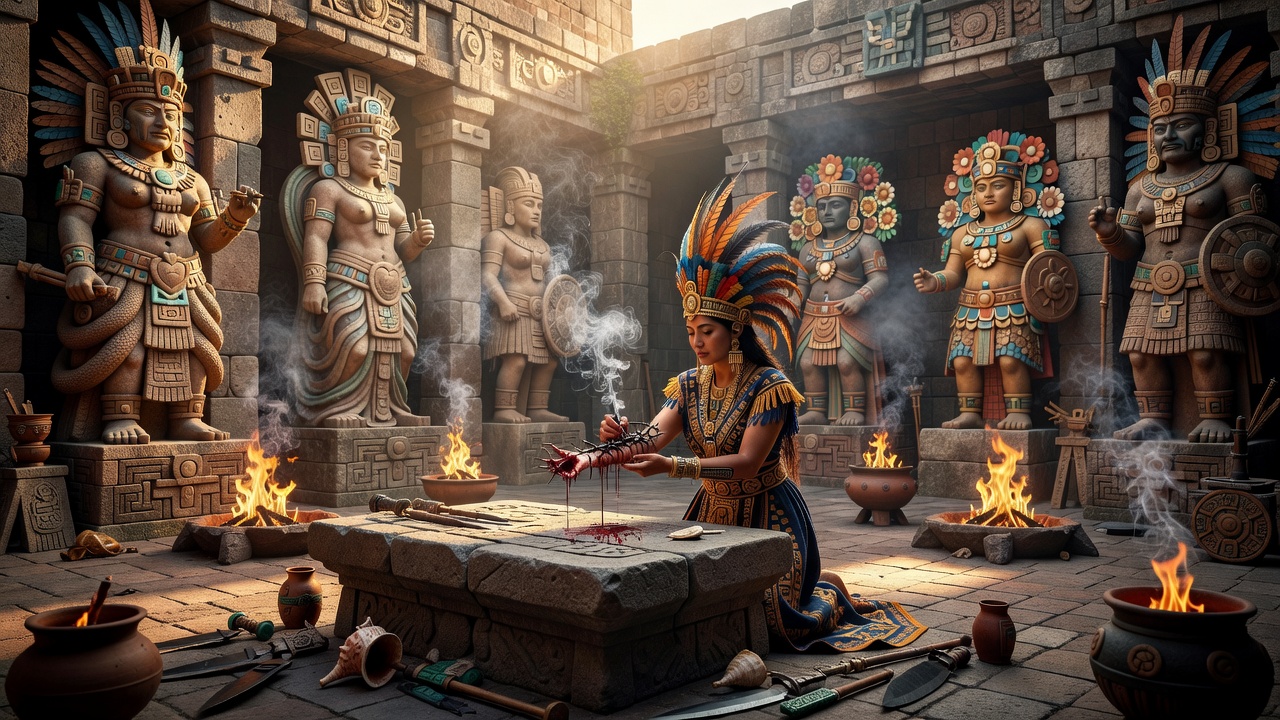
Blood, obsidian, and cotton smoke defined the daily rhythm of religious life in Tenochtitlan. Priestesses rose before dawn to draw their own blood with maguey thorns, fasted for days at a stretch, and tended fires that were never permitted to go out. This was not symbolic devotion. It was a full-time occupation with strict hierarchies, specialized training, and consequences for failure that ranged from public shame to death. The women who filled these roles occupied a position in Aztec society that modern audiences rarely hear about, overshadowed by the more frequently discussed male priesthood and the empire's warrior culture.
Yet the record, pieced together from colonial-era codices, archaeological digs at the Templo Mayor, and accounts written by Spanish chroniclers who interviewed surviving Nahua elders, shows a religious system where female spiritual authority was indispensable. An Aztec priestess did not simply assist male clergy; she managed her own temples, trained novices, and communicated directly with goddesses tied to fertility, the earth, and the moon. For readers who enjoy exploring this history through interactive entertainment, the aztec priestess slot offers a stylized glimpse into that world, translating temple imagery and ritual symbolism into a modern format. The sections that follow examine the temples these women served, the rituals they performed, and the goddesses whose will they were believed to carry out.
Who Was the Aztec Priestess? Roles, Training, and Daily Life
The Aztec priestess, known in Nahuatl by titles that varied according to rank and temple assignment, was not a marginal figure. She held administrative, educational, and ceremonial authority within a religious bureaucracy that paralleled the male priesthood in complexity, even though it operated on a smaller scale and with different sacred obligations.
Selection and Early Training
Girls entered temple service, called the cihuacalli or "house of women," often around age twelve or thirteen. Some were dedicated by their parents as an act of piety or in fulfillment of a vow; others were chosen based on lineage, particularly if their families held hereditary ties to specific cults. Training lasted years and included memorization of hymns, calendar calculations, herbal medicine, weaving of ceremonial textiles, and the strict comportment expected of someone who represented a goddess in the eyes of the community.
Hierarchy Within the Temple
Not every priestess held equal rank. At the top stood senior women who oversaw novices and managed temple property, including stores of maize, cotton, and copal incense. Below them worked women responsible for specific tasks: sweeping sacred precincts, preparing ritual foods, maintaining perpetual fires, and producing the intricate garments worn during festivals. This division of labor mirrored the meticulous organization found throughout Aztec administration.
Life After Service
Contrary to assumptions of permanent celibacy, many priestesses eventually left temple life to marry, carrying prestige from their years of service into their new households. Others remained for life, particularly those attached to the most demanding cults, such as those devoted to Cihuacoatl or Toci, where lifelong dedication was expected and socially honored.
- Entry age typically between 12 and 15 years old
- Training covered ritual song, calendar knowledge, and textile production
- Hierarchy ranged from novices to senior temple administrators
- Service could be temporary or lifelong depending on the deity and cult
Aztec Goddesses and Their Sacred Symbolism
Aztec religion recognized a dense pantheon in which goddesses controlled forces as fundamental as childbirth, agriculture, and the fate of warriors who died in battle. Understanding these figures explains why the priesthood dedicated to them required such rigorous preparation.
Coatlicue: Mother of the Gods
Coatlicue, whose name translates to "Serpent Skirt," embodied the paradox at the heart of Aztec cosmology: she was both creator and devourer, giver of life and consumer of the dead. Her monumental stone statue, unearthed in Mexico City in the eighteenth century, depicts a figure wearing a skirt of writhing serpents and a necklace of human hands and hearts, a visual language meant to convey the terrifying reciprocity between life and death.
Chalchiuhtlicue and the Waters of Life
Chalchiuhtlicue, goddess of lakes, rivers, and childbirth, received offerings whenever a child was born or a canal was dug. Priestesses associated with her cult specialized in water-based purification rites, and midwives often invoked her name during labor, treating birth itself as a sacred crossing overseen by divine feminine power.
Xochiquetzal: Beauty, Fertility, and Craft
Xochiquetzal governed love, flowers, and the skilled arts, particularly weaving and featherwork. Her festivals involved elaborate floral displays and performances by young women trained specifically in her honor, reinforcing the connection between artistic mastery and religious devotion.
Toci and Cihuacoatl: The Fierce Mothers
Toci, "Our Grandmother," and Cihuacoatl, the "Snake Woman," represented a harsher maternal archetype, associated with midwifery but also with omens, war, and the anguished cries said to precede disaster. Their cults required some of the most intense priestly commitment, including nightly vigils and specialized fasting regimens.
Inside the Ancient Aztec Temple: Architecture and Sacred Space
Temple architecture in the Aztec world was never decorative for its own sake. Every platform, staircase, and shrine encoded cosmological meaning, positioning the structure as a bridge between the human and divine realms.
The Templo Mayor: Center of the Universe
At the heart of Tenochtitlan stood the Templo Mayor, a twin-pyramid complex dedicated to Huitzilopochtli, god of war and the sun, and Tlaloc, god of rain and agriculture. Archaeological excavation beginning in 1978 revealed multiple construction phases, each layer reflecting an expansion of imperial power and religious ambition. This ancient Aztec temple functioned as the symbolic axis mundi, the point where earth, sky, and underworld intersected.
Smaller Shrines and Neighborhood Temples
Beyond the capital's central precinct, smaller temples dotted residential districts (calpulli), each serving local deities and community-specific rites. These neighborhood shrines were often where priestesses had the most direct daily contact with ordinary families, officiating minor ceremonies tied to harvests, illness, or coming-of-age milestones.
Sacred Furnishings and Ritual Tools
Temple interiors housed braziers for burning copal, stone altars stained from repeated ceremonies, and storage rooms for ritual garments woven by resident priestesses. Obsidian blades, feather headdresses, and painted codices used for calendar tracking were kept under careful guard, treated as extensions of divine presence rather than mere tools.
Aztec Ritual Practices: Ceremonies, Offerings, and Sacrifice
Ritual in Aztec religion operated on the principle of reciprocity: the gods had given the world its order through their own sacrifice, and humans owed a continuous debt that had to be repaid through offerings, bloodletting, and, in specific circumstances, human sacrifice.
Bloodletting and Personal Penance
Autosacrifice, drawing blood from the ears, tongue, or thighs using maguey spines or stingray spines, was practiced by both priests and priestesses as an everyday act of devotion, not reserved solely for major festivals. This practice reflected the belief that human blood carried tonalli, a vital life force the gods required to sustain cosmic order.
Festival Cycles and the Sacred Calendar
The 260-day ritual calendar, the tonalpohualli, worked alongside the 365-day solar calendar to schedule an unending sequence of ceremonies. Each month brought a distinct festival, often tied to agricultural cycles or specific deities, requiring priestesses to prepare offerings of maize, flowers, copal, and woven textiles well in advance.
Human Sacrifice and Its Religious Logic
Human sacrifice, while shocking to modern sensibilities, was framed within Aztec cosmology as a necessary act to keep the sun moving and prevent cosmic collapse. Priestesses played specific, though less publicized, roles in certain sacrificial rites, particularly those tied to female deities where women impersonators of the goddess were ritually honored before their death, a practice recorded in detail for the festival of Toci.
- Bloodletting performed as daily personal penance
- Festivals scheduled according to the 260-day tonalpohualli
- Offerings included maize, copal incense, and woven cloth
- Certain goddess festivals involved ritual impersonation by female participants
Aztec Mythology and the Stories Behind the Rituals
Ritual practice cannot be separated from the myths that justified it. Aztec cosmology described a universe that had already been destroyed and recreated multiple times, and every ceremony reenacted some portion of that mythic struggle.
The Five Suns and Cosmic Cycles
According to Aztec myth, the world had passed through four previous ages, or "suns," each ending in catastrophe. The current age, the Fifth Sun, depended on continuous offerings to prevent a similar fate, giving ritual sacrifice its cosmological urgency rather than framing it as arbitrary cruelty.
Divine Feuds and the Birth of Huitzilopochtli
The myth of Huitzilopochtli's birth, in which he emerged fully armed to defend his mother Coatlicue from his jealous siblings, mirrored the political reality of the Aztec state defending itself against rival city-states. This story was retold during major festivals, reinforcing both religious and imperial legitimacy simultaneously.
Modern Reinterpretations of Aztec Myth
Contemporary culture continues to draw on this mythology in unexpected formats, from museum exhibitions to digital entertainment. An Aztec mythology slot game, for instance, might feature symbols drawn from Coatlicue's serpent skirt or Huitzilopochtli's hummingbird imagery, introducing new audiences to figures they might never encounter in a traditional history course.
Legacy of the Aztec Priestess in Modern Culture
Spanish colonization dismantled the formal priesthood by the mid-sixteenth century, yet fragments of this religious tradition persisted through syncretism, oral history, and archaeological recovery.
Colonial Suppression and Cultural Survival
Missionaries actively worked to erase indigenous religious practice, often replacing goddess veneration with Catholic saints who absorbed similar attributes, a substitution visible today in certain devotional practices across central Mexico.
Archaeological Rediscovery
Excavations at the Templo Mayor since the late twentieth century have recovered ritual deposits, sculptures, and offerings that confirm details from colonial texts, giving historians physical evidence to corroborate written accounts of priestess activity and goddess worship.
Aztec Themes in Contemporary Media
Beyond scholarship, Aztec imagery appears across film, literature, and gaming, keeping figures like Coatlicue and Xochiquetzal visible to audiences who might otherwise never study Mesoamerican history in depth.
Frequently Asked Questions
What was the actual title given to an Aztec priestess?
Titles varied by rank and cult, but general terms like cihuatlamacazqui referred to women dedicated to temple service. Specific goddess cults often had unique titles tied to the deity they served, reflecting the specialized nature of each religious office.
Did Aztec priestesses perform human sacrifice themselves?
Most sacrificial acts were carried out by male priests, but priestesses held central roles in rituals involving female deity impersonators, particularly during festivals honoring Toci and other maternal goddesses. Their involvement focused more on preparation, ritual dressing, and ceremonial oversight than on the act of sacrifice itself.
How does the Templo Mayor connect to Aztec goddess worship?
While the Templo Mayor primarily honored Huitzilopochtli and Tlaloc, surrounding shrines and buried offerings reveal dedications to goddesses like Coyolxauhqui, whose dismembered stone image was discovered at the base of the pyramid. This find confirms that female deities held integral, not peripheral, positions within the capital's central religious complex.
Were all Aztec goddesses associated with fertility?
No. While figures like Chalchiuhtlicue and Xochiquetzal governed fertility and childbirth, others such as Cihuacoatl carried associations with war, omens, and death. The pantheon reflected a broad range of feminine divine power extending well beyond reproduction.
Can I still see original Aztec temple ruins today?
Yes. The Templo Mayor archaeological site sits in the heart of Mexico City, adjacent to the Metropolitan Cathedral, and remains open to visitors along with its dedicated museum housing recovered artifacts and sculptures.
Why do Aztec goddesses and priestesses appear in modern games and media?
Their striking iconography, dramatic mythology, and rich symbolism translate well into visual and narrative entertainment. Designers often draw directly on documented imagery, such as serpent motifs or ceremonial dress, to create products that carry genuine cultural resonance rather than generic fantasy themes.