Post-Quantum Encryption Outpaces Classical Methods on Tiny IoT Chips
A long-standing assumption in cybersecurity engineering has been overturned: post-quantum cryptography, widely presumed too heavy for small internet-connected devices, can actually run faster and more efficiently than the elliptic curve methods currently protecting them. Researchers at Edinburgh Napier University found that combining two lattice-based algorithms, ML-KEM and ML-DSA, allowed an ESP32 microcontroller to complete secure connection handshakes up to 8.9 times faster than with conventional cryptography.
Why this challenges existing engineering wisdom
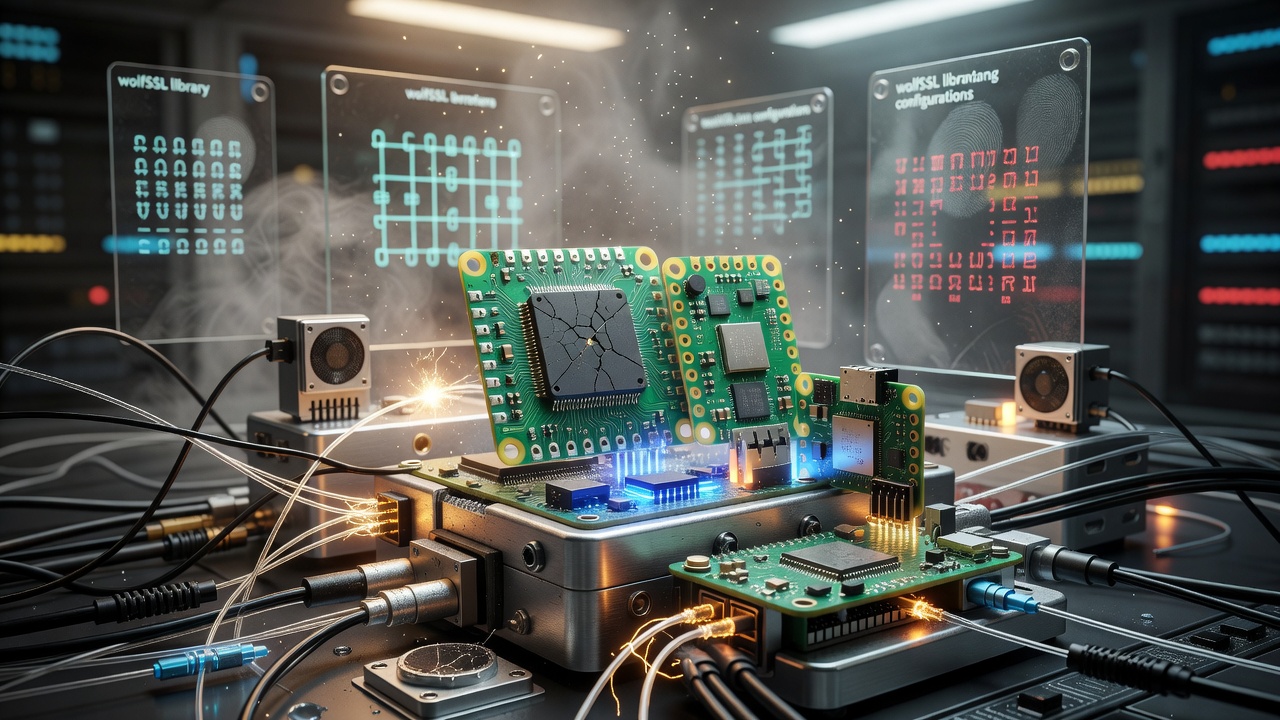
Elliptic curve cryptography, exemplified by algorithms like X25519, has dominated secure communications for small devices because it offers strong security with relatively modest computational demands. Post-quantum alternatives, built on lattice mathematics rather than prime number factorization, were expected to impose heavier burdens on processors with limited memory and power budgets, such as those found in Raspberry Pi Pico boards and ESP32 chips widely used in smart sensors, thermostats, and industrial monitoring equipment. The new benchmarking results, which tested thirty-six different cryptographic configurations within the wolfSSL library, suggest that assumption no longer holds. ML-KEM, a key exchange mechanism, and ML-DSA, a digital signature scheme, both rely on the mathematical difficulty of solving structured grid-like problems rather than factoring large primes. That structural difference appears to translate into genuine computational advantages on constrained hardware, not merely theoretical security gains.
What the numbers actually show
The most striking result came from pairing ML-KEM-512 with ML-DSA-44 on an ESP32, which completed TLS 1.3 handshakes, the standard process by which two devices establish an encrypted connection, up to 8.9 times faster than the traditional combination of X25519 and RSA-PSS. On a Raspberry Pi Pico W, a different pairing using ML-KEM-768 alongside ML-DSA-44 delivered roughly 41 percent faster handshakes and as much as 2.12 times better energy efficiency, depending on which authentication method was selected. These are not marginal improvements. For battery-powered sensors or devices deployed in remote locations, handshake speed and energy consumption directly determine operational lifespan and responsiveness.
Why the timing matters
Governments and standards bodies have been pushing organizations to migrate toward quantum-resistant cryptography over the coming decade, anticipating that sufficiently powerful quantum computers could eventually break the mathematical problems underpinning today's encryption. That pressure has created a dilemma for manufacturers of connected devices: hybrid approaches, which combine classical and post-quantum algorithms as a safety net, have generally been treated as the pragmatic middle path, since pure post-quantum implementations were assumed to carry unacceptable performance costs on weak hardware. These findings complicate that reasoning. If fully post-quantum configurations can match or exceed classical performance, developers may no longer need to accept the added complexity of hybrid schemes simply to protect against future quantum threats.
What comes next
The research does not suggest every device or every configuration will see identical gains; performance varied depending on which specific algorithm pairing and hardware platform were tested. But it does reframe a central question facing the Internet of Things industry: rather than asking whether quantum-safe cryptography is affordable for small devices, developers may increasingly ask which post-quantum combination performs best for their particular constraints. Given the sheer scale of IoT deployment, from home automation to industrial infrastructure, the practical implications of this shift could extend well beyond laboratory benchmarks.